


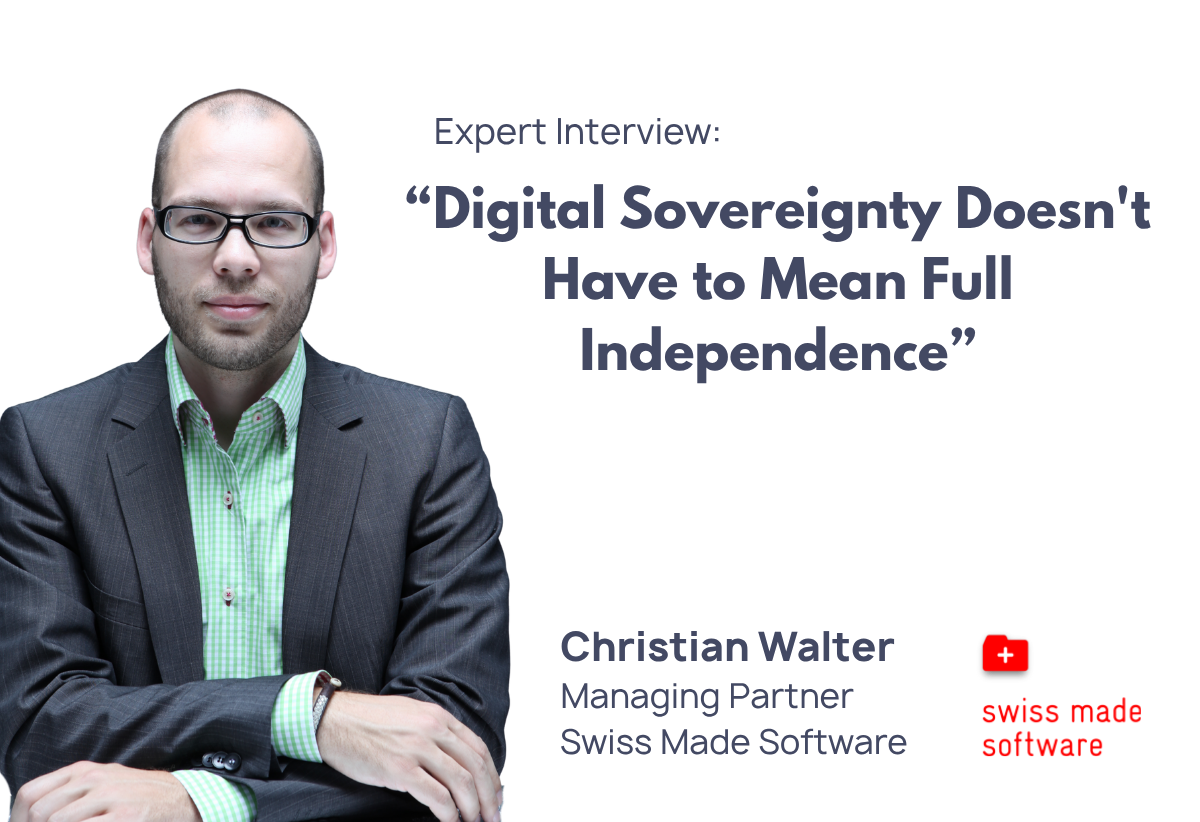
The conversation around digital sovereignty and technological dependency has never been more relevant. swiss made software works to make Swiss software companies more visible and to help organizations make smarter decisions about the tech they rely on. We sat down with Christian Walter, Managing Partner at swiss made software, to talk digital sovereignty and the challenges facing Switzerland's IT industry.
How has swiss made software's membership grown over the past few years and what's driving that?
Christian Walter: We've seen strong growth. On average, around 100 companies joined per year. Last year was a record, with roughly 200 new members. Today, our community includes about 1,500 companies from across Switzerland. What's especially rewarding is that we're represented in all language regions of the country. That's actually pretty unusual in the Swiss IT world, where most organizations tend to be regionally focused.
What does a swiss made software membership get organizations?
The biggest benefit is being able to use our labels in marketing and communications. Companies can show that their products or services are substantially developed in Switzerland. In the context of digital sovereignty, that kind of proof of origin has become significantly more valuable. We offer three labels: swiss made software for products, swiss digital services for services, and swiss hosting for hosting and SaaS offerings. Together, they give companies a transparent way to demonstrate their Swiss value creation.
Why does it matter to choose Swiss software solutions right now?
We're seeing more and more Swiss companies paying close attention to who they work with. Questions like "Who picks up the phone?", "Where are the employees based?" or "Where is my data being processed?" are carrying real weight. The current geopolitical climate has sharpened that awareness considerably. For many organizations, where a tech solution comes from is no longer just a marketing point, it's part of their risk management strategy. Our labels help create transparency and put Swiss alternatives to global tech giants on the map.
How do you define digital sovereignty?
For us, digital sovereignty doesn't mean full independence – because full independence isn't realistic. Switzerland doesn't manufacture its own chips, and we depend on international supply chains for a lot of technology. What matters is critical digital sovereignty. Companies need to ask themselves: which systems are essential to our operations, and what risks do we take on when we become dependent on a single vendor or country?
Are there limits to digital sovereignty in a globally connected world?
Absolutely! You don't have to do everything yourself. The real goal is to consciously define which areas are strategically important and which services you're comfortable sourcing from international partners. That kind of collaboration isn't going away. But for business-critical systems, it's worth thinking carefully about the risks that political or economic shifts could create. That's exactly where digital sovereignty becomes meaningful.
How does swiss made software contribute to Switzerland's digital sovereignty?
Our three labels can be understood as building blocks of digital sovereignty. They create transparency about where products are developed, where services are delivered, and where data is stored. That gives companies and organizations the information they need to make informed decisions about which dependencies they're willing to accept, and where they want to deliberately choose Swiss providers.
How do you help Swiss companies get more visibility?
Members benefit from the recognition our labels carry and from being part of the swiss made software network. On our platform, we also offer extensive presentation options: companies can list their products and services, add categories, and tag them with relevant keywords. This generates landing pages that rank well in search engines and drive additional visibility. One of our most successful features is "Swiss Alternatives" — a section where Swiss companies can position themselves as alternatives to international providers like Dropbox, SAP, or Azure. It's been getting a lot of traction, especially in conversations around digital sovereignty.
How do your labels work in practice – how do you make sure the criteria are being met?
Every company goes through a manual review process. Labels aren't awarded automatically. Beyond a formal check, that includes a personal onboarding interview. We look at where development takes place and who's directly working on the product. The basis for both swiss made software and swiss digital services is Switzerland's "Swissness" provision: at least 60% of the relevant development costs must be incurred in Switzerland. The focus is on the employees directly involved in building the software. Functions like marketing or sales don't factor into the evaluation.
Where do you see the biggest challenges for Swiss software companies right now?
Geopolitical tensions, economic uncertainty, and the rapid pace of AI development all make long-term planning harder. On the AI front, there's an enormous amount of hype right now. It's genuinely difficult to predict what the long-term impact on software development will be. That makes it all the more important to follow developments closely, without panicking or rushing into premature action.
How do you support knowledge-sharing and collaboration within the community?
We foster exchange through our platform, through events like the Swiss Software Festival – which is happening for the second time in 2026 – and through direct contact with our members. The onboarding interviews are especially valuable to us. That's where we hear firsthand about the challenges companies are facing and what they actually need. A lot of new initiatives grow directly out of those conversations. Our goal is to listen to our members and turn what we learn into real value for the community.
Event tip: The Swiss Software Festival on the 24th of June 2026 brings together software companies and tech enthusiasts to celebrate the growth of Switzerland's software industry.

.svg)



 Xelon AG Poststrasse 15, 6300 Zug Switzerland
