


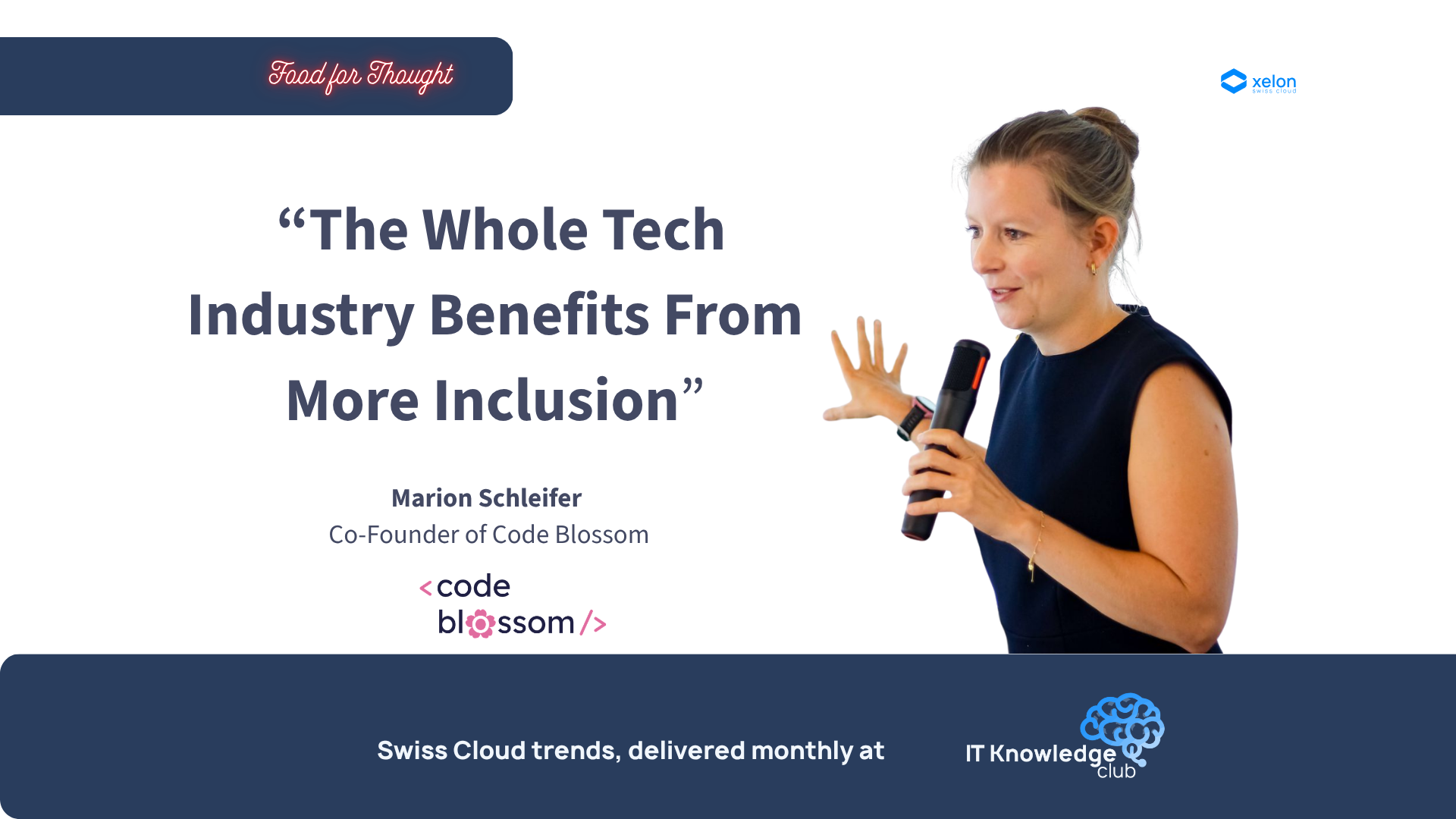
At Xelon, we believe reliable technology should be within reach for everyone. Code Blossom makes that happen where it's hardest. Founded in 2024, the Swiss non-profit teaches women and refugees in developing countries to code and use AI. In our interview, co-founder Marion Schleifer told us what holds her participants back, and what happens when they're given a real opportunity.
Can you please explain, in your own words, what Code Blossom does?
Marion Schleifer: Code Blossom is a Swiss non-profit association that provides free software development and AI education to women and refugees in developing countries. We run programs for women in Kenya, Namibia and Malawi, and for refugees in Kenya and Uganda. We offer two programs: “Full-Stack Development” and “Digital and AI Skills for Women Running Small Businesses.” In addition to technical skills, all participants join our “Beyond Coding” sessions. These cover soft skills like time management, professional behavior in the workplace and conflict resolution, which are essential for succeeding in a job or running a business.
We focus on applied skills that participants can use in practice right away. Our participants learn things they can use the next day, not just theory. What matters just as much is the community. People encourage each other, share what they've figured out and check in when someone goes quiet. When something hits, like a flood or a death in the family, that's often the reason they stay.
How did your own path lead you to co-found Code Blossom? Was there a moment you thought “I’ll do this!”?
I don't have a technical background myself. I studied multilingual communication and then did a master's in business administration before I decided to learn how to code. Along the way, a lot of people helped me, both friends and family and colleagues during my internship. They gave up their free time to explain how software development works and let me try out what I'd learned on real projects. I wanted to pass that kindness on. So in 2015, I co-founded a free weekly programming course for women in Zurich, which is still running today. Later, I co-founded Women Techmakers Switzerland and organized community events for women in tech.
The moment came when I traveled to some of the countries we work in now. I met women who had the intelligence, the time and the motivation, and some even had laptops and internet access. What they didn't have were opportunities. That's why I started Code Blossom: to create those opportunities and, at the same time, make the tech industry a bit more diverse.
What has been the most rewarding moment for you since co-founding Code Blossom?
In 2025, a group of refugees in Uganda called me and asked if they could join Code Blossom. They had tried to learn to code on their own but kept hitting walls, and they needed mentors. So I said yes, even though it was a mixed group and our programs had been for women only until then. There were 15 of them, sharing three laptops. I was amazed by how hard they worked. They didn't give up, and they used the group to help each other understand new concepts.
In March 2026, I bought laptops for the rest of the group myself, and what happened next really blew my mind. Their progress went through the roof. Just two months later, the group leader told me they had landed paid work for clients in the US and the Democratic Republic of the Congo. The best part: they found those clients on their own, without any help from Code Blossom. More projects followed, and today, eight people from that group earn money with their new skills. Hearing that they made it against all odds was the most rewarding moment for me.
What excites you most about your work?
For me, that is seeing our participants grow. Watching them pick up technical skills is great, but it goes much further than that. In our “Beyond Coding” sessions and our book clubs, where we read about talent and how we learn, women start to realize that they can learn anything they set their minds to. They become more confident. Many who were too shy to answer a question at the start speak up more and more as they go through the program. Sarah from Uganda put it beautifully on her first portfolio website: “I was once just a refugee girl, raised by a single parent, who believed that I did not have what it takes to do something great - something that would make others proud. [...] From a girl who once believed she couldn't, to a woman learning that she can.”
How can you ensure Code Blossom creates lasting impact?
That's a good question, especially now that AI is changing everything so quickly. Even though we teach technical skills, what participants actually learn is how to learn. Getting to grips with new concepts and putting them into practice will matter more and more in uncertain times. And learning software development as an adult really trains that muscle. We also keep reminding our participants that in tech, it's up to you to keep up with the latest trends and try things out. That's the mindset we want them to leave with: being able to adapt, even if the world of tech changes completely. So far, it's working. More than 70% of our graduates now have jobs or projects in the tech industry.
What barriers do women in developing countries face when learning to code or acquiring digital literacy? How does Code Blossom help them overcome these barriers?
They face many. The first is that some women don't get access to education at all because their families won't allow it. That can be because they're needed at home, or because of cultural beliefs that women shouldn't be educated. Some of these women never make it to us. Those who do still face obstacles. When the family or the family business needs help, women are usually the first to give up their studies or their job. Many also care for children, siblings or in-laws, which leaves little time to learn. Their own goals tend to come last, so plans can change at any moment.
We address this in two ways: through how our programs are set up and through our community guidelines. Our programs run remotely. We sometimes offer in-person workshops for certain cohorts, but they're optional, and participants can graduate without attending. That way, women with caregiving responsibilities can learn from home. Learning times are also completely flexible, so participants who are busy during the day can study early in the morning or in the evening. And if something happens in their family or community that needs their full attention, we let them take a break, even a long one. Some participants come back after months away.
When somebody is learning to code, how much does the underlying infrastructure – their setup, tools, or Cloud environment – help or hold them back?
A lack of basic infrastructure like laptops, electricity and internet access is the biggest barrier for underserved people learning digital skills. That's why we provide laptops to our most vulnerable participants wherever our budget allows. We also cover electricity costs for refugees and give all participants data bundles, so a lack of internet doesn't stop them from learning.
IT infrastructure stays important once our participants start working. For the small-business owners we train, predictable costs are key: a surprise bill can wipe out a large part of a month's profit. And they need IT that simply works, because every hour of downtime is an hour they can't work efficiently and serve their customers.
Looking ahead, what is your vision for the future of Code Blossom and the women it supports?
I want us to start scaling on two fronts: our “Digital and AI Skills for Women Running Small Businesses” program in Kenya and our program for refugees. In both cases, we've started building partnerships with the UN. We're in talks with UN Women about the business program, and we've already signed a memorandum of understanding with UNHCR, the UN Refugee Agency, for a program in Kakuma refugee camp in Kenya. In November 2026, I did a scouting mission to Kakuma to see what works on the ground. Based on that, we'll develop a program that teaches refugees the skills they need to become self-reliant. I'm hopeful these partners will help us raise the funds we need to scale both projects and increase our impact.
What specific advice would you give to women and female-identifying people who want to enter or grow in the tech industry?
You don't need to be good at math, and you don't need to love gaming to become a software developer. Those two beliefs stop a lot of women from even trying, and they held me back for a while, too. Anyone can learn to code if they have the motivation and willpower to take on something new that takes a lot of practice.
My second piece of advice: develop a bit of a thick skin. As a woman, you're often the only one on an otherwise all-male team. That isn't always easy, and sometimes it means dealing with stereotypes or even sexism. The good news is that many companies have a truly inclusive culture. So if you experience discrimination, the best thing you can do is move on. If a team doesn't respect you, find one that does. They exist.
Why is diversity important for the tech industry?
Tech products should work for everyone. But if they're created by a very homogeneous team, they'll likely work best for people who are similar to the ones who built them. To create products that work for everyone, we need teams with people of different backgrounds, ethnicities, genders, sexual orientations and more. And it's not only about inclusion. It's also about revenue: if my product works for everyone, I can sell it to more people and make more money. So really, this should be a no-brainer.
What do you wish you had known ten years ago?
That you can't help everyone, and that you can't make people want a better life for themselves. Without intrinsic motivation, it's impossible to teach someone or to convince them that new skills will pay off later. And that's okay. Some people don't want it enough to stick with the program. Some realize coding isn't for them. And some simply have other priorities at that point in their lives. If they want to come back later, our doors are always open. But it's up to them to decide what's best for them.
How can people (with or without a background in tech) support your mission?
The most effective way is to donate. All donations go straight to our projects: we only pay local employees and contractors, and nobody in Switzerland takes a salary. If you'd like to support a specific country (Kenya, Namibia, Malawi or Uganda) or a specific cause (women or refugees), just mention it in the payment reference, and we'll make sure your donation goes there.
You can also help by spreading the word about Code Blossom, whether you tell people in your network about us or engage with our posts on social media. And we're always happy to connect with like-minded people and organizations. That could lead to new partnerships down the road.




 Xelon AG Poststrasse 15, 6300 Zug Switzerland

